


BROWSE PECO PRODUCTS
Browse through our complete product portfolio.
162 Products Found
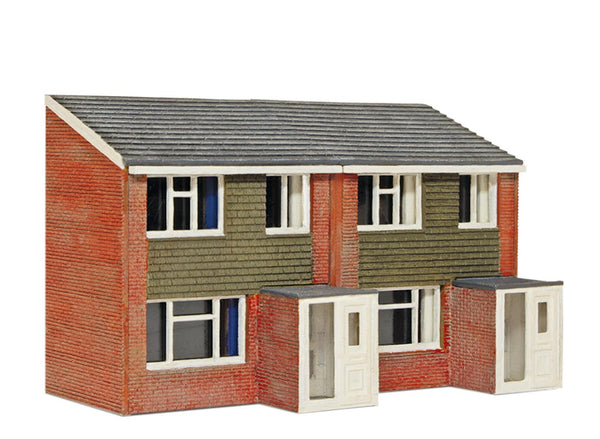
1960s House Front - L/Cut Kit
During the 1960s, British semi-detached houses reflected a period of post-war recovery and growing suburban prosperity. As Britain rebuilt from wartime damage and expanded its suburbs, demand for affordable family homes surged. Semi-detached houses became the ideal solution — cost-effective, spacious, and suited to modern lifestyles. Built mainly from brick or concrete with simple geometric designs, they often featured large windows, central heating, and private gardens. Unlike the ornate Victorian or interwar styles, 1960s semis embraced functionalism and minimal ornamentation, echoing modernist influences. Many were constructed as part of large housing estates on city outskirts, supported by improved road networks and rising car ownership. These homes symbolised optimism, mobility, and the shift toward suburban living, forming a lasting part of Britain’s mid-20th-century architectural identity.
- Laser cut wood kits with finely rendered detailing
- Each kit representing a typical 1960s style semi detached block of two houses, front elevation, rear elevation and complete building.
- Can be joined up to create a longer block, terrace.
- Front porch can be fitted as an optional extra
- Scope for further interior decoration (not provided)
- Complement our earlier releasee of Victorian Houses – kits NB306, NB307, NB308, also in N
-
Additional upsell products available form the ratio range such as:
- 300 Guttering and Downpipes
- 307 Chimneys
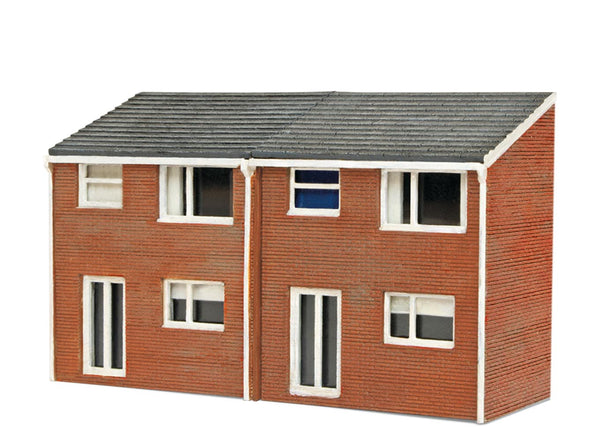
1960s House Back - L/Cut Kit
During the 1960s, British semi-detached houses reflected a period of post-war recovery and growing suburban prosperity. As Britain rebuilt from wartime damage and expanded its suburbs, demand for affordable family homes surged. Semi-detached houses became the ideal solution — cost-effective, spacious, and suited to modern lifestyles. Built mainly from brick or concrete with simple geometric designs, they often featured large windows, central heating, and private gardens. Unlike the ornate Victorian or interwar styles, 1960s semis embraced functionalism and minimal ornamentation, echoing modernist influences. Many were constructed as part of large housing estates on city outskirts, supported by improved road networks and rising car ownership. These homes symbolised optimism, mobility, and the shift toward suburban living, forming a lasting part of Britain’s mid-20th-century architectural identity.
- Laser cut wood kits with finely rendered detailing
- Each kit representing a typical 1960s style semi detached block of two houses, front elevation, rear elevation and complete building.
- Can be joined up to create a longer block, terrace.
- Front porch can be fitted as an optional extra
- Scope for further interior decoration (not provided)
- Complement our earlier releasee of Victorian Houses – kits NB306, NB307, NB308, also in N
-
Additional upsell products available form the ratio range such as:
- 300 Guttering and Downpipes
- 307 Chimneys
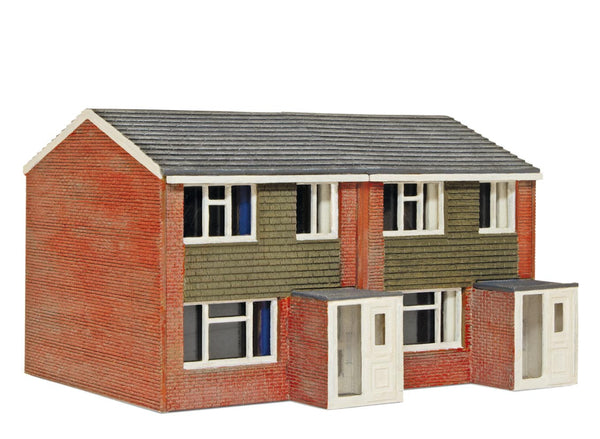
1960s House Complete - L/Cut Kit
During the 1960s, British semi-detached houses reflected a period of post-war recovery and growing suburban prosperity. As Britain rebuilt from wartime damage and expanded its suburbs, demand for affordable family homes surged. Semi-detached houses became the ideal solution — cost-effective, spacious, and suited to modern lifestyles. Built mainly from brick or concrete with simple geometric designs, they often featured large windows, central heating, and private gardens. Unlike the ornate Victorian or interwar styles, 1960s semis embraced functionalism and minimal ornamentation, echoing modernist influences. Many were constructed as part of large housing estates on city outskirts, supported by improved road networks and rising car ownership. These homes symbolised optimism, mobility, and the shift toward suburban living, forming a lasting part of Britain’s mid-20th-century architectural identity.
- Laser cut wood kits with finely rendered detailing
- Each kit representing a typical 1960s style semi detached block of two houses, front elevation, rear elevation and complete building.
- Can be joined up to create a longer block, terrace.
- Front porch can be fitted as an optional extra
- Scope for further interior decoration (not provided)
- Complement our earlier releasee of Victorian Houses – kits NB306, NB307, NB308, also in N
-
Additional upsell products available form the ratio range such as:
- 300 Guttering and Downpipes
- 307 Chimneys
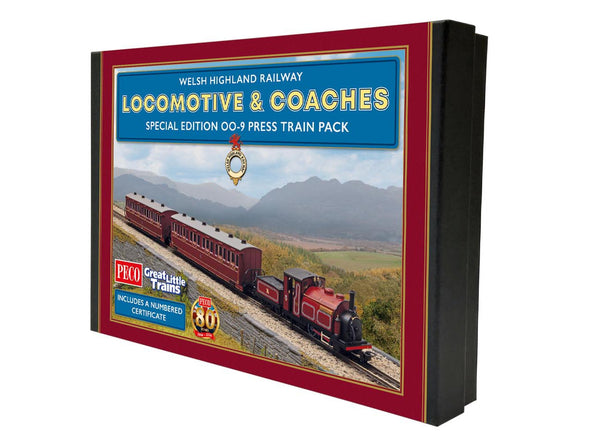
Special Edition OO-9 Press Train Pack (Welsh Highland Railway)
The Ffestiniog Railway, located in North Wales, is the world’s oldest surviving independent railway company, founded in 1832. Originally built to transport slate from the quarries of Blaenau Ffestiniog to the port at Porthmadog, it was engineered with a unique narrow gauge of just 1 ft 11½ in (597 mm), ideal for winding through the rugged Snowdonia landscape. Innovative features included gravity-powered slate trains running downhill and horses hauling the wagons back uphill.
In the 1860s, steam locomotives were introduced, making the Ffestiniog the first narrow-gauge railway in the world to successfully use them. After declining slate demand led to closure in 1946, dedicated volunteers began restoring the line in the 1950s. Today, it runs as a popular heritage railway, linking Porthmadog to Blaenau Ffestiniog once again, and is celebrated for its pioneering engineering, scenic beauty, and remarkable preservation story.
These latest PECO train packs celebrate that legacy with attention to authenticity and a passion for detail.
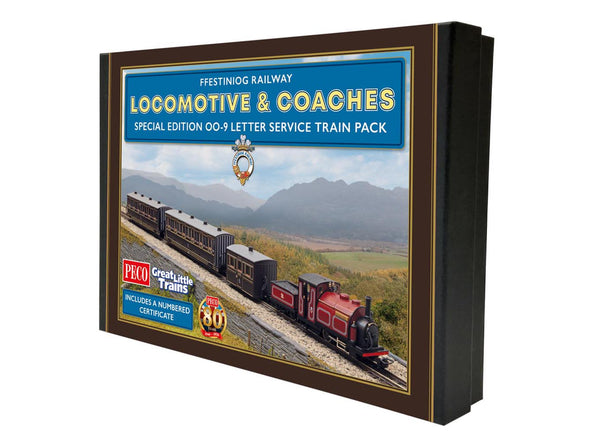
Special Edition OO-9 Letter Service Train Pack (Ffestiniog Railway)
The Ffestiniog Railway, located in North Wales, is the world’s oldest surviving independent railway company, founded in 1832. Originally built to transport slate from the quarries of Blaenau Ffestiniog to the port at Porthmadog, it was engineered with a unique narrow gauge of just 1 ft 11½ in (597 mm), ideal for winding through the rugged Snowdonia landscape. Innovative features included gravity-powered slate trains running downhill and horses hauling the wagons back uphill.
In the 1860s, steam locomotives were introduced, making the Ffestiniog the first narrow-gauge railway in the world to successfully use them. After declining slate demand led to closure in 1946, dedicated volunteers began restoring the line in the 1950s. Today, it runs as a popular heritage railway, linking Porthmadog to Blaenau Ffestiniog once again, and is celebrated for its pioneering engineering, scenic beauty, and remarkable preservation story.
These latest PECO train packs celebrate that legacy with attention to authenticity and a passion for detail.
2026 Railway Modeller Special (The Annual)
Online Deal- Limited offer £9.99 including Postage
The wonderful creative pastime of model railways is celebrated in the 2026.
Railway Modeller Special, produced by the publisher of Railway Modeller, the UK’s market-leading model railway title with the highest ABC audited readership., Railway Modeller remains unique in British model railway publishing, as it is part of a company that is long-associated with the industry, namely the world famous PECO model railway brand.
• Journey along the Somerset & Dorset – from Bath Green Park to Bournemouth West
• Thurlestone & Bullhouse – a celebration of pre-Grouping steam in OO
• Railways before 1825 – the story of rail evolution before Locomotion
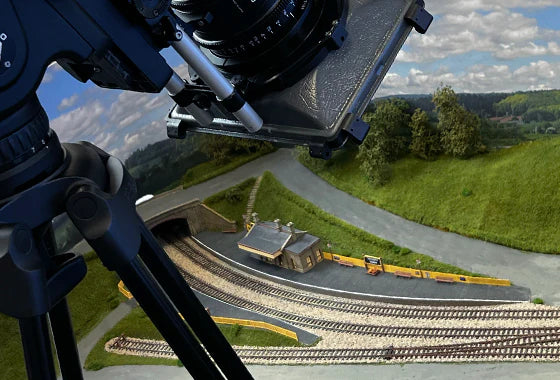
• Smoke and mirrors – a model railway diorama for photographic subterfuge
• Along Alpine lines – riding the Swiss metre-gauge Rhaetian Railway
• Modelling tips and inspiration; manufacturer profile; and much, much more…