


BROWSE PECO PRODUCTS
Browse through our complete product portfolio.
1192 Products Found
The Great Model Railway Challenge
New, from the experts at RAILWAY MODELLER!
HIT TV SHOW SPECIAL, A COLLECTORS ITEM AND THE COMPANION TO SERIES 2 OF THE POPULAR CHANNEL 5 SHOW!

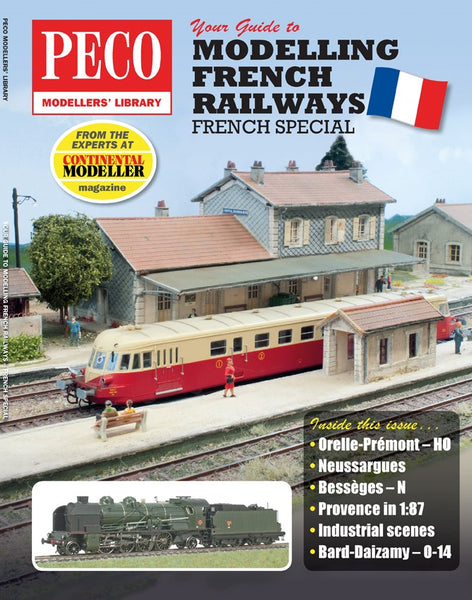
Your Guide to Modelling French Railways
France is a land of rail contrasts; the popular image of a local train ambling through the countryside has long since given way to the smart, speedy TVG.
In places the landscape required impressive feats of civil engineering, even on the secondary routes, which meandered cross-country between the busy mainlines.
Nowadays unique tourist railways add to the appeal.
Here is just a small selection to inform and inspire.
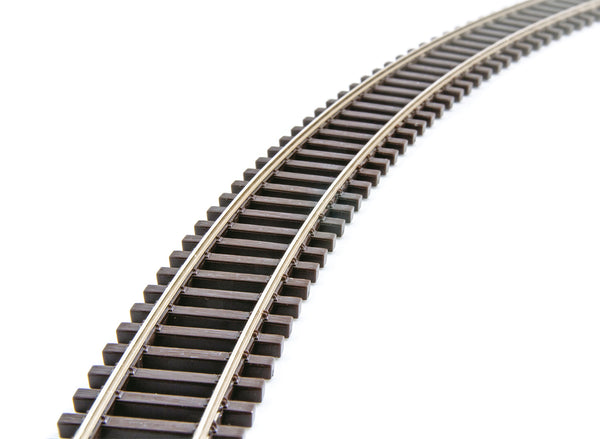
TT:120 C55 Flexible Track, Wooden Sleeper
Code 55
Use SL-310 metal joiners and SL-1208 joining sleepers. Use SL-311 insulating joiners to create isolated track sections (if using DCC control these are not required).
One of the great advantages of TT:120 is that the 12mm gauge track correctly scales out as standard (4' 8.5") gauge, as used all over Britain's railway network. The ingenious rail section of PECO code 55 combines strength and durability with a highly realistic appearance – In TT:120 the visible height of the rail correctly represents 113lb flat bottom rail. The flexible sleeper base is detailed with fine wood grain and spikes through British Railways’ BR1 baseplates under the rails, a combination that continues to be widely used on Britain’s railways.
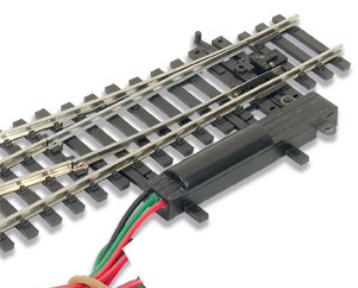
Power Feed Joiners (Pack of 8)
204mm track feed wires ready soldered to rail joiners. Quick and easy to use, avoids the risk of damage to sleepers from soldering irons. Easily extended using PL-39 Terminal Blocks and PL-38 Red and Black wire. 4 pairs per pack.

Layering Spray
The Pecoscene Static Grass range enables modellers to produce realistic fields, grassed areas, moorlands and embankments. The Static Grass Applicators PSG-1 and 2 electrostatically charge the grass filaments so that they stand vertically, regardless of the terrain. Mixing various lengths and colours of grasses can produce highly realistic textures and effects. Our Shows You How Booklet No 13 Detailing the Landscape and Youtube video clips show the effects that can be created.

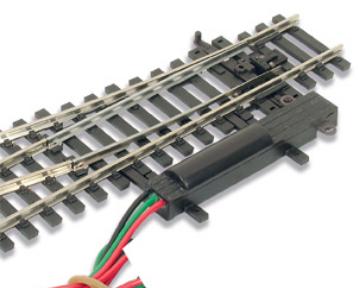
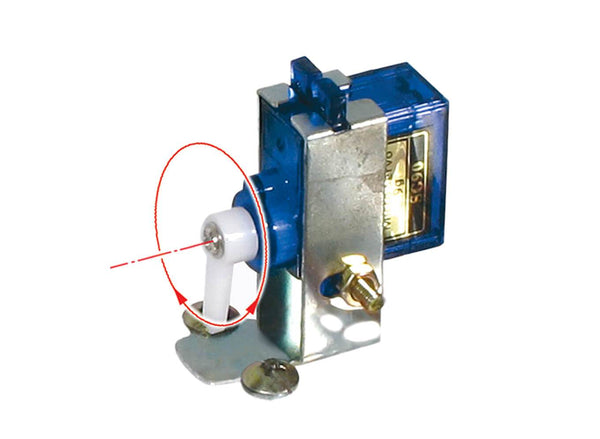
Smartswitch Single Servo Motor
The Smartswitch(TM) system can be used to operate turnouts, semaphore signals, level crossing gates and barriers and other moving features. This Servo can be used in conjunction with the PLS-120 Control Board. Watch the videos to see the potential uses and ease of installation of this system and see our Shows You How booklet No. 24 Operating Points and Signals.
Soft-grip Craft Knife No.11 Blades
A specially selected tool from expert modellers here at PECO for kit building. A scalpel handle with disposable scalpel blades. For cutting plastic components.
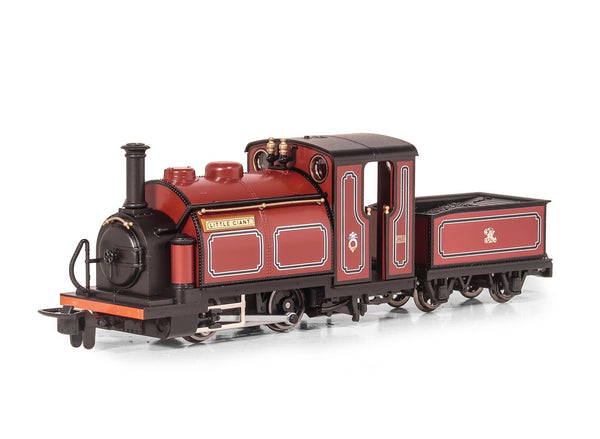
OO-9 Large England PECO/KATO Locomotive - 'Little Giant' (Maroon)
Available now!
Narrow gauge ready-to-run locomotives in 1:76 scale, 9mm gauge track. DC (analogue) core-less motor fitted within loco body giving smooth and reliable running. Loco and tender electrically connected – pick ups on front loco axles and two tender axles. Inner axle of loco fitted with traction tyres. Will comfortably negotiate 9inch/229mm radius curves. Fully decorated with fine lining and small details. Separate moulding supplied for handrails, and other details. Supplied fitted with standard PECO OO-9 coupling, Arnold N gauge couplings supplied separately.
Please note: DCC operation is possible with this model but it is not currently supplied as 'DCC-Ready' and will need to be carefully retro-fitted.
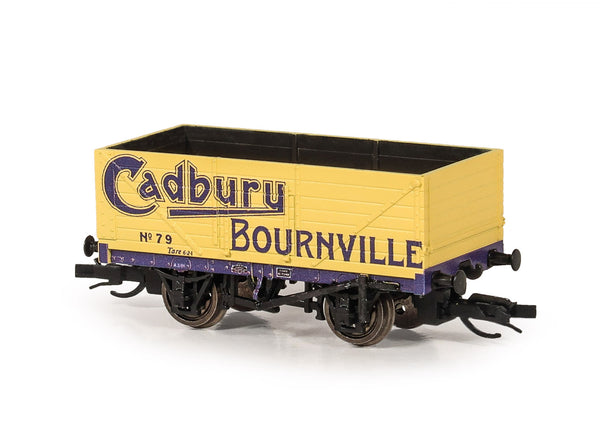
TT:120 7-Plank Open Wagon, Cadbury Bourneville
- Fine plastic moulding with thinner wagon body walls for accuracy.
- Interior detail as well as a high-level of exterior detail
- Separately-fitted brake lever.
- Brake shoes in line with the wheels
- Ultra-fine printing detail
- Free-running metal-tyred wheels
- Standard (removable) TT:120 coupler compatible with other TT:120 rolling stock on the market
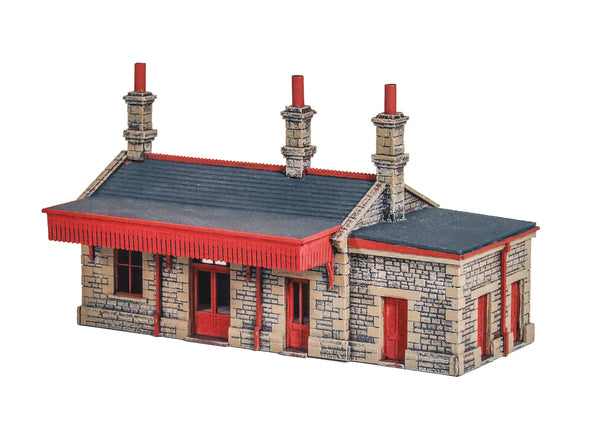
TT:120 Country Station Kit
Laser cut wooden kit with plastic chimney pot detail and glazing sheet.
A craft knife, needle files, glue (impact adhesive or PVA work well. Superglue can also be used apart from the glazing) and paints are required.
Stone-built country station building with canopy on the platform side. Based on West Bay in Dorset, originally built by the Bridport Railway and later absorbed by the Great Western Railway.
Technical Specifications
Length 115mm
Width 47mm Canopy projects 17mm
TT:120 GWR Signal Box Kit
Laser cut wooden kit with plastic chimney pot detail and glazing sheet.
A craft knife, needle files, glue (impact adhesive or PVA work well. Superglue can also be used apart from the glazing) and paints are required.
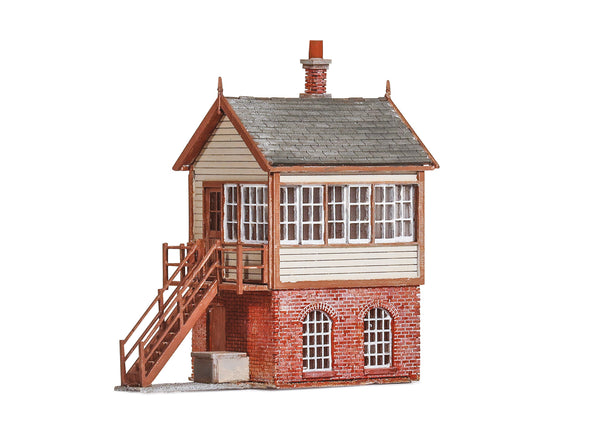
A signalbox suitable for a small country station, based on Highley on the Severn Valley Railway (with thanks to the SVR for allowing access to measure it).
Technical Specifications
Length 65mm (including steps)
Width 32mm
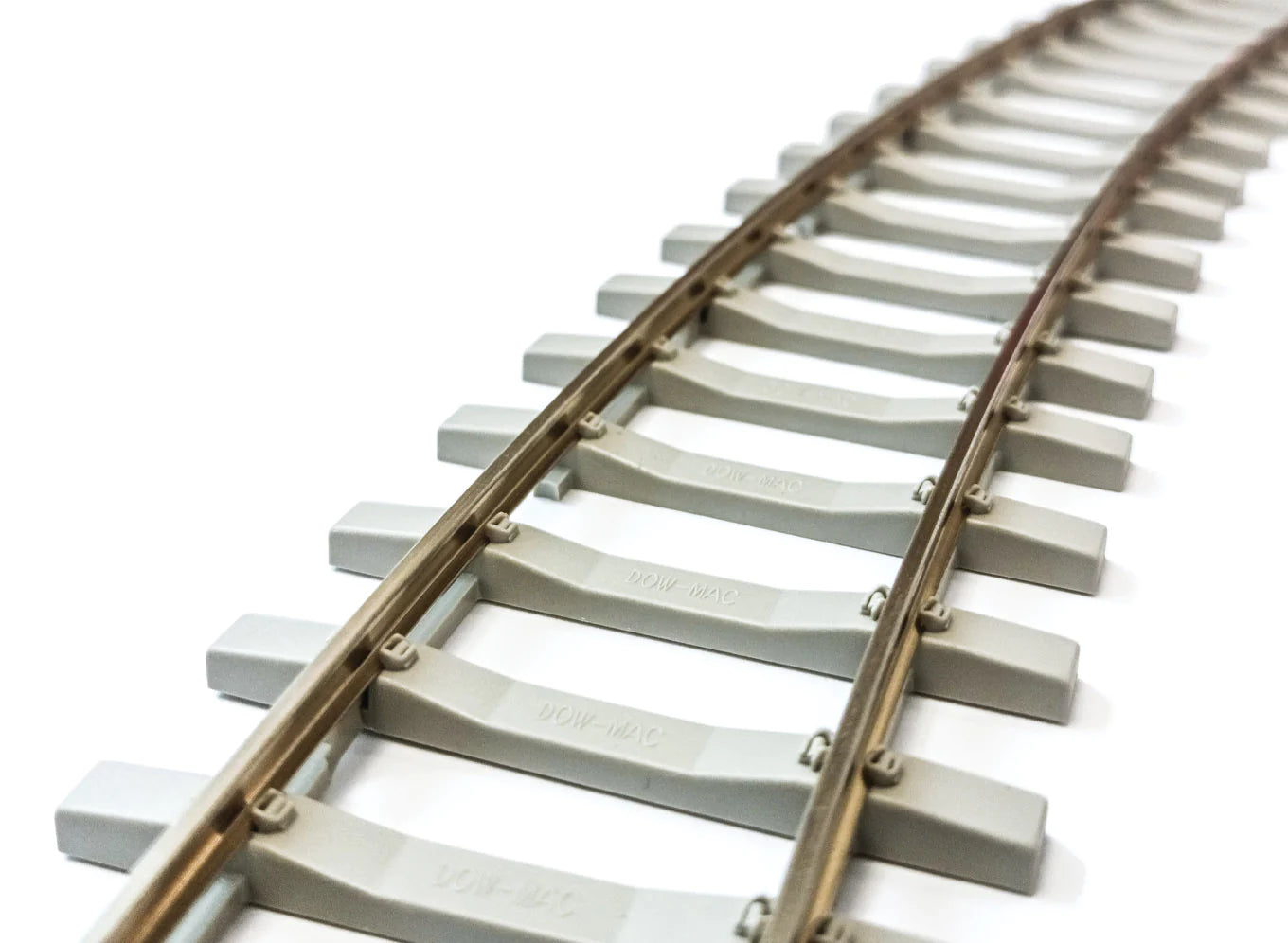
Flexible Track, Concrete Sleeper
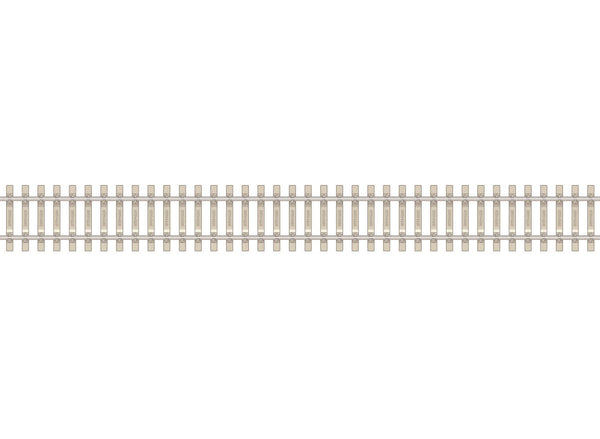
Concrete sleeper track has been in use on the railways of Britain since around 1940, usually combined with wooden sleeper turnouts and crossings, and this track is a faithful representation of this design.
If you wish to mix wheel standards on your 00/H0 layout, this is the trackage to choose. Code 100 rail allows flange depths up to 1.6mm which means that both vintage and current stock will run happily together. The wide range of turnouts and crossings in this series includes every type, and the geometry of this range has been cleverly designed to make it easy to build convenient, complex and aesthetically pleasing formations.
Turnout, Medium Radius, Concrete, Left Hand
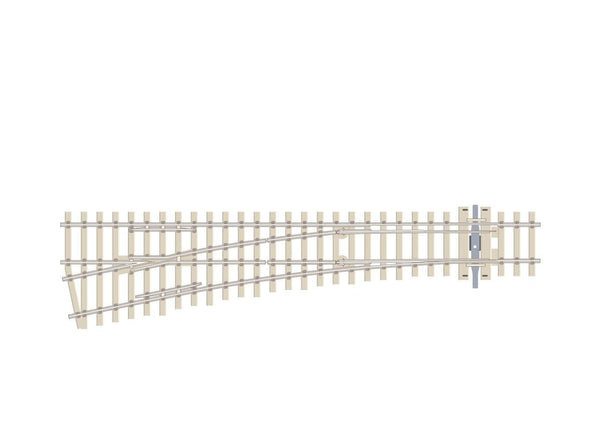
These turnouts emulate the modern style of concrete sleepered trackwork which features Pandrol (TM) style rail fixings. Concrete sleepered turnouts had previously been impractical due to the concrete being broken by the impact caused as wheels passed through the frog area. This has been resolved by redesigning the frog so that the flange supports the wheel across the gap in the running rail.
Peco Streamline Code 75 track meets the standards of enthusiasts who prefer to run trains on scale height rail. Today most manufacturers' wheels are suitable for use on Code 75 track but some vintage models may have flanges which are too deep to clear the rail fixings. Code 75 can be easily combined with code 100 track by using the SL-113 Transition Track.
The wide range of turnouts and crossings in this series includes every type, and the geometry of this range has been cleverly designed to make it easy to build convenient, complex and aesthetically pleasing formations using combinations of small, medium and large radius turnouts and crossings. Layout plans suggestions can be found in our publications ‘Track Plans for Layouts to Suit all Locations’ (Ref PM-202), ‘60 Plans for Small Railways’ (Ref no PB-3), and ‘Track Plans for Various Locations’ (Ref no PB-66).
For more details on Electrofrog turnouts, see our Wiring the Layout publications Nos 4 and 21.
Pro Grass Micro Applicator
The Pecoscene Static Grass range enables modellers to produce realistic fields, grassed areas, moorlands and embankments. The Static Grass Applicators PSG-1, 2 and 3 electrostatically charge the grass filaments so that they stand vertically, regardless of the terrain. The PSG-1 applicator is designed for creating medium to large areas, such as lawns, fields, moorlands etc. Mixing various lengths and colours of grasses can produce highly realistic textures and effects. Our Shows You How Booklet No 13 Detailing the Landscape and Youtube video clips show the effects that can be created.

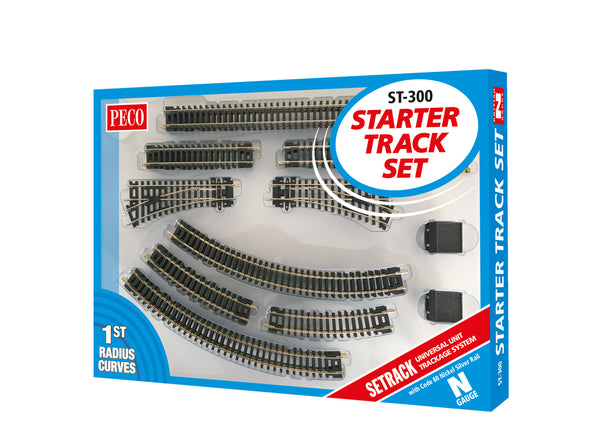
Starter Track Set - 1st Radius - N Gauge
This pack includes:
- 6 x ST-1 Standard Straights
- 3 x ST-11 Double Straights
- 5 x ST-3 1st Radius Standard Curves
- 6 x ST-12 1st Radius Double Curves
- 1 x ST-5 Right Hand Turnout
- 1 x ST-6 Left Hand Turnout
- 2 x ST-8 Buffer Stops
- 2 x ST-9 Power Connecting Clips
- 1 x IN-1 N Setrack Planbook
This pack can be used in conjunction with the ST-301 N Setrack 2nd Radius Starter Track set to create a double track layout.
PECO Setrack N Gauge Code 80 - Unit trackage System
The high quality rigid unit trackage system suitable for all popular brands of N gauge model trains.
Being fully compatible with both Code 80 and Code 55 PECO Streamline, it need never be discarded as your layout develops.
The solid nickel silver rails are integrally moulded into the sleeper bases for maximum realism and strength. Turnouts are fitted with an over-centre spring for immediate use, no extra levers necessary.
Transition Tracks
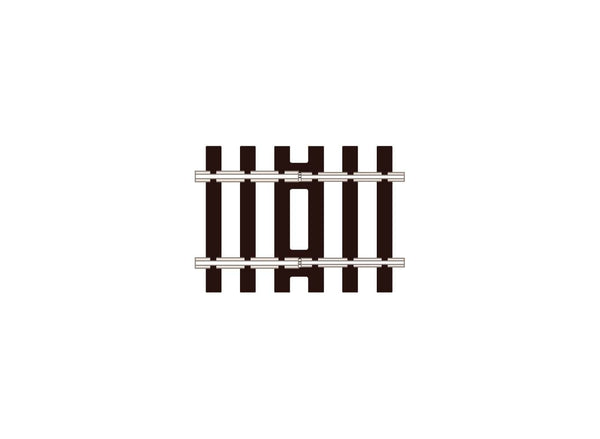
For use between sections of Code 100 and Code 75 track, so for example could be used to incorporate a Code 75 Asymmetric 3- way Turnout (SL-E199) into a Code 100 layout, or to connect a Code 100 Streamline or Setrack 'fiddle yard' to a Code 75 scenic section.
Normally conductive; although the electrical connections between the 2 rail types can be cut to provide an electrical break. Supplied in a pack of 4.
Bullhead 00 Gauge Streamline Track
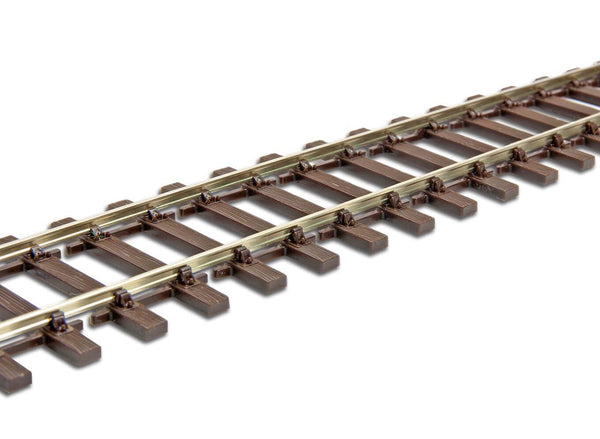
Bullhead track has been in use on the railways since the earliest times, and is still very much in evidence today. This flexible track provides a highly detailed and faithful 00 scale replication of this long standing feature of Britain's railways.
Our SL-114 Bullhead Rail Joiners include bolt detail and therefore complement the fine detail of this track range.
Large Sky with Clouds Backscene
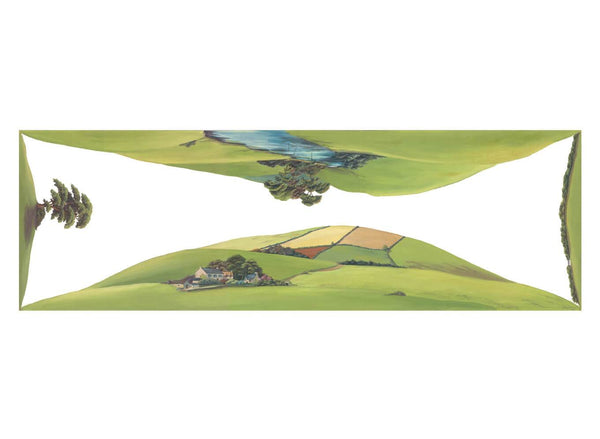
Our scenic background range captures the variety on the British landscape, from industrial cities and docks to small country towns, fields and mountains. The sheets can be assembled in almost any combination, consistent horizon heights and special extension sheets make it easy to accommodate transitions from town to countryside and back again. The choice of sheet size will obviously depend to some degree on the model scale. Bear in mind that perspective only ever makes things appear smaller not larger, so if you are unsure, remember 1 golden rule. A backscene that appears to be a larger scale than the foreground models will always look wrong.

Large Conversion Landscape Backscene
Our scenic background range captures the variety on the British landscape, from industrial cities and docks to small country towns, fields and mountains. The sheets can be assembled in almost any combination, consistent horizon heights and special extension sheets make it easy to accommodate transitions from town to countryside and back again. The choice of sheet size will obviously depend to some degree on the model scale. Bear in mind that perspective only ever makes things appear smaller not larger, so if you are unsure, remember 1 golden rule. A backscene that appears to be a larger scale than the foreground models will always look wrong.
4mm Summer Grass
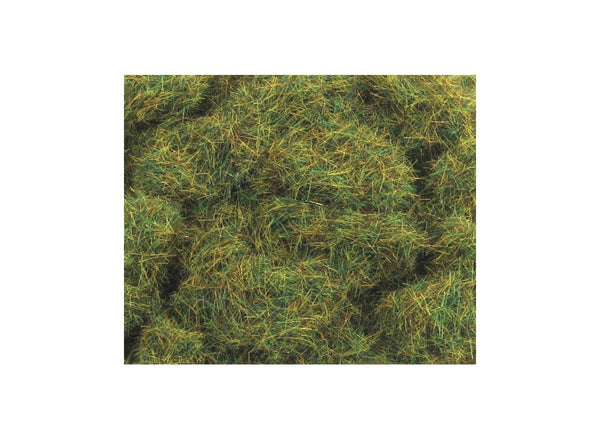
The Pecoscene Static Grass range enables modellers to produce realistic fields, grassed areas, moorlands and embankments. The Static Grass Applicators PSG-1 and 2 electrostatically charge the grass filaments so that they stand vertically, regardless of the terrain. Mixing various lengths and colours of grasses can produce highly realistic textures and effects. Our Shows You How Booklet No 13 Detailing the Landscape and Youtube video clips show the effects that can be created.
Smartswitch Set
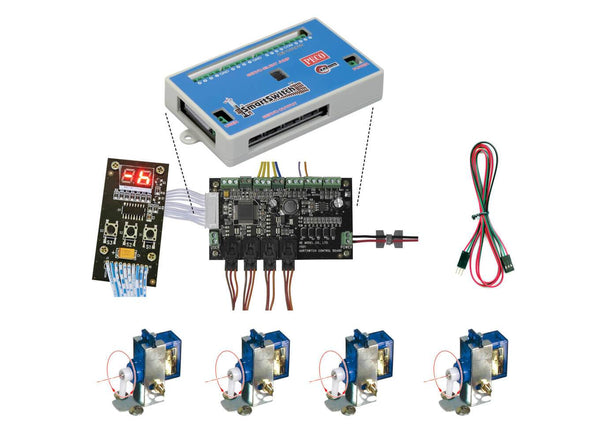
The Smartswitch(TM) system can be used to operate turnouts, semaphore signals, level crossing gates and barriers and other moving features. This set contains 4 Servos, operating wires, mounting brackets and switches plus a Smartswitch Control Board, Programming Board and also the all important Instruction Manual. Watch the videos to see the potential uses and ease of installation of this system and see our Shows You How booklet No. 24 Operating Points and Signals.
Engine Shed, Brick Type
Plastic kit of an attractive single track shed with pre coloured roof, walls and doors. Multiple kits can be easily used together to create a larger loco facility.

Girder Bridge Side, Truss Girder Type, Grey
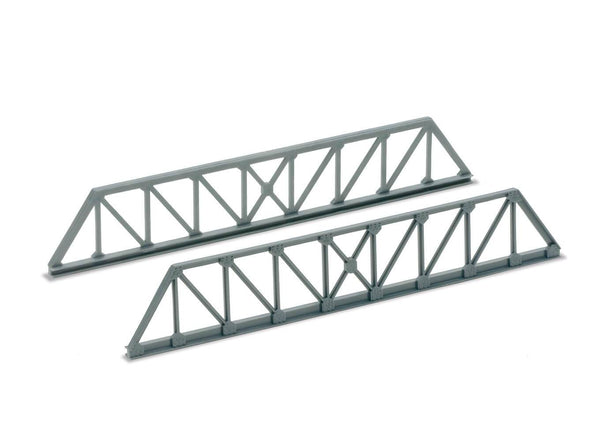
Can be used with Ratio 254 Stone Piers to create an impressive viaduct as seen on many railways around the world. Detailed plastic moulding supplied 2 in a pack.
Manyways' Overall Roof
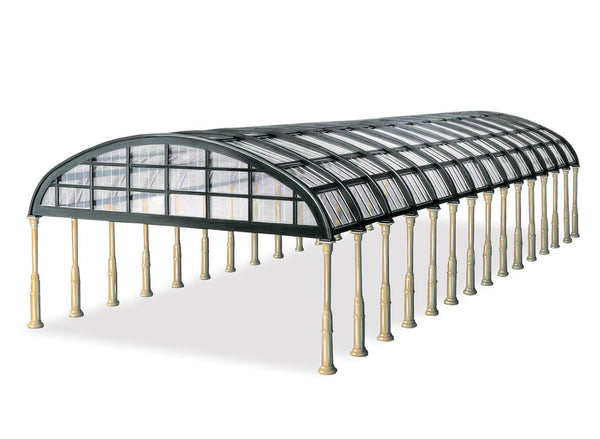
A kit of pre coloured and clear parts that can be built in a number of different ways and can be stood on a platform or on ground level.
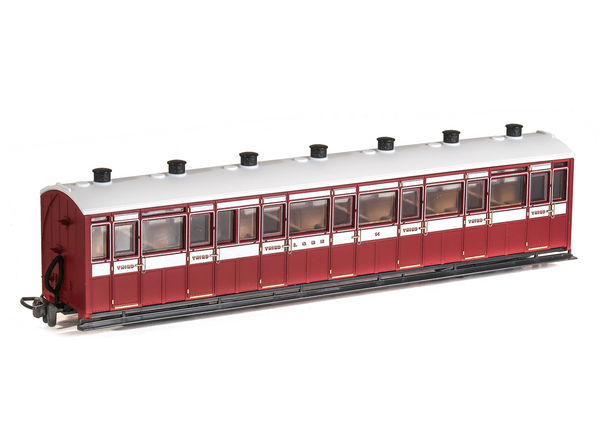
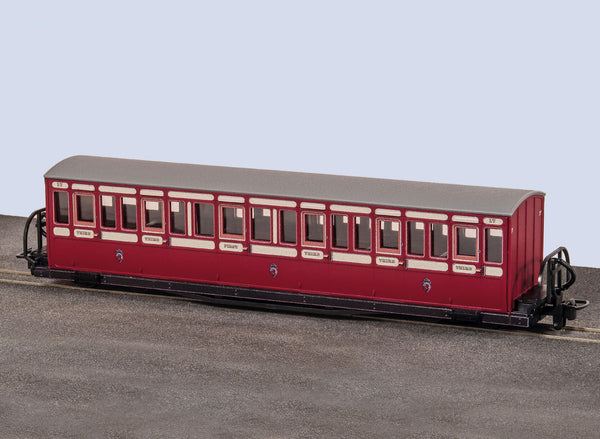
OO-9 All 3rd Coach Lynton and Barnstaple Livery No 14
These finely detailed ready to run coaches and wagons are accurately modelled on the rolling stock of the Lynton and Barnstaple Railway, both as an independent railway and after its' absorption into the Southern railway in 1922. They are also available painted but unlettered for those modellers who wish to tailor them for use on other lines.
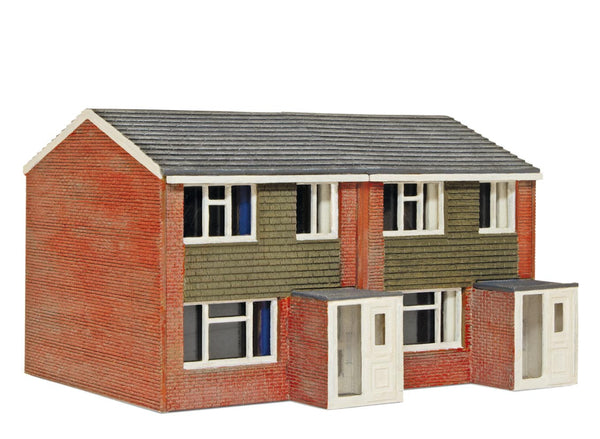
1960s House Complete - L/Cut Kit
During the 1960s, British semi-detached houses reflected a period of post-war recovery and growing suburban prosperity. As Britain rebuilt from wartime damage and expanded its suburbs, demand for affordable family homes surged. Semi-detached houses became the ideal solution — cost-effective, spacious, and suited to modern lifestyles. Built mainly from brick or concrete with simple geometric designs, they often featured large windows, central heating, and private gardens. Unlike the ornate Victorian or interwar styles, 1960s semis embraced functionalism and minimal ornamentation, echoing modernist influences. Many were constructed as part of large housing estates on city outskirts, supported by improved road networks and rising car ownership. These homes symbolised optimism, mobility, and the shift toward suburban living, forming a lasting part of Britain’s mid-20th-century architectural identity.
- Laser cut wood kits with finely rendered detailing
- Each kit representing a typical 1960s style semi detached block of two houses, front elevation, rear elevation and complete building.
- Can be joined up to create a longer block, terrace.
- Front porch can be fitted as an optional extra
- Scope for further interior decoration (not provided)
- Complement our earlier releasee of Victorian Houses – kits NB306, NB307, NB308, also in N
-
Additional upsell products available form the ratio range such as:
- 300 Guttering and Downpipes
- 307 Chimneys
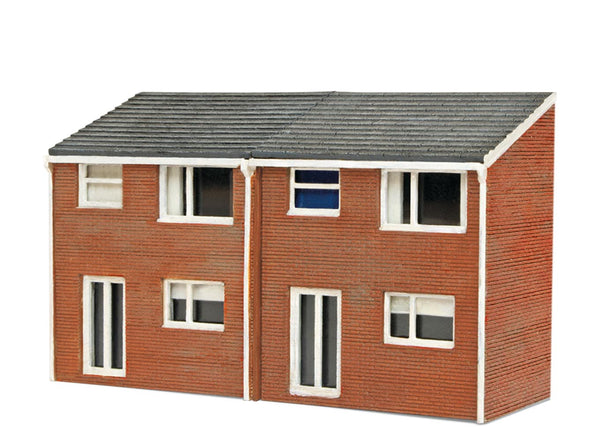
1960s House Back - L/Cut Kit
During the 1960s, British semi-detached houses reflected a period of post-war recovery and growing suburban prosperity. As Britain rebuilt from wartime damage and expanded its suburbs, demand for affordable family homes surged. Semi-detached houses became the ideal solution — cost-effective, spacious, and suited to modern lifestyles. Built mainly from brick or concrete with simple geometric designs, they often featured large windows, central heating, and private gardens. Unlike the ornate Victorian or interwar styles, 1960s semis embraced functionalism and minimal ornamentation, echoing modernist influences. Many were constructed as part of large housing estates on city outskirts, supported by improved road networks and rising car ownership. These homes symbolised optimism, mobility, and the shift toward suburban living, forming a lasting part of Britain’s mid-20th-century architectural identity.
- Laser cut wood kits with finely rendered detailing
- Each kit representing a typical 1960s style semi detached block of two houses, front elevation, rear elevation and complete building.
- Can be joined up to create a longer block, terrace.
- Front porch can be fitted as an optional extra
- Scope for further interior decoration (not provided)
- Complement our earlier releasee of Victorian Houses – kits NB306, NB307, NB308, also in N
-
Additional upsell products available form the ratio range such as:
- 300 Guttering and Downpipes
- 307 Chimneys
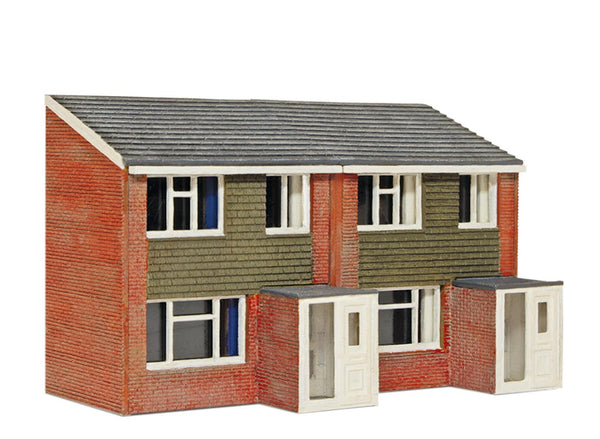
1960s House Front - L/Cut Kit
During the 1960s, British semi-detached houses reflected a period of post-war recovery and growing suburban prosperity. As Britain rebuilt from wartime damage and expanded its suburbs, demand for affordable family homes surged. Semi-detached houses became the ideal solution — cost-effective, spacious, and suited to modern lifestyles. Built mainly from brick or concrete with simple geometric designs, they often featured large windows, central heating, and private gardens. Unlike the ornate Victorian or interwar styles, 1960s semis embraced functionalism and minimal ornamentation, echoing modernist influences. Many were constructed as part of large housing estates on city outskirts, supported by improved road networks and rising car ownership. These homes symbolised optimism, mobility, and the shift toward suburban living, forming a lasting part of Britain’s mid-20th-century architectural identity.
- Laser cut wood kits with finely rendered detailing
- Each kit representing a typical 1960s style semi detached block of two houses, front elevation, rear elevation and complete building.
- Can be joined up to create a longer block, terrace.
- Front porch can be fitted as an optional extra
- Scope for further interior decoration (not provided)
- Complement our earlier releasee of Victorian Houses – kits NB306, NB307, NB308, also in N
-
Additional upsell products available form the ratio range such as:
- 300 Guttering and Downpipes
- 307 Chimneys
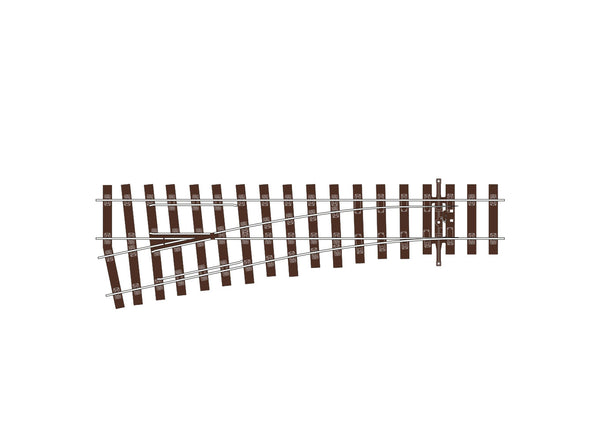
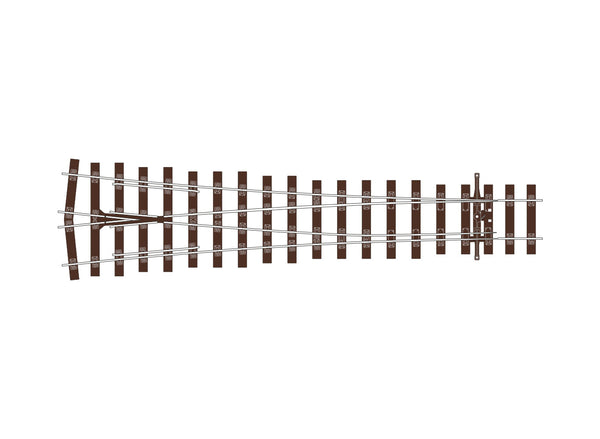
OO Bullhead Small Radius Turnout - Left Hand
The PECO Streamline OO Bullhead track range has shaped up to be a very comprehensive system comprising flexible track, bullhead joiners, buffer stop, large radius, medium radius turnout, a crossing, double & single slips, Y turnouts and now Small Radius Turnouts. There's enough there already for modellers to build a truly authentic steam-to-diesel transition period layout.
- PECO Streamline OO Bullhead Small Radius Turnout, Unifrog
- Shares the same geometry as the existing Streamline Code 100, 75 flat bottom tracks systems
- Compatible with existing Bullhead system
- Uses standard SL-110 Code 75 rail joiner or the SL-114 Bullhead rail joiner
- Length 185mm
- Radius 610mm
- Frog angle 12 degrees
- Unifrog
- High quality nickel silver rail for all rail parts, for optimal electrical conductivity
- An excellent track component where space restrictions prevent standard turnouts being used.
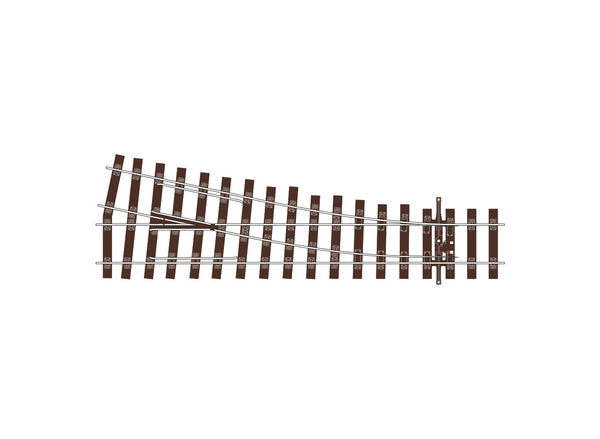
OO Bullhead Small Radius Turnout - Right Hand
The PECO Streamline OO Bullhead track range has shaped up to be a very comprehensive system comprising flexible track, bullhead joiners, buffer stop, large radius, medium radius turnout, a crossing, double & single slips, Y turnouts and now Small Radius Turnouts. There's enough there already for modellers to build a truly authentic steam-to-diesel transition period layout.
- PECO Streamline OO Bullhead Small Radius Turnout, Unifrog
- Shares the same geometry as the existing Streamline Code 100, 75 flat bottom tracks systems
- Compatible with existing Bullhead system
- Uses standard SL-110 Code 75 rail joiner or the SL-114 Bullhead rail joiner
- Length 185mm
- Radius 610mm
- Frog angle 12 degrees
- Unifrog
- High quality nickel silver rail for all rail parts, for optimal electrical conductivity
- An excellent track component where space restrictions prevent standard turnouts being used.
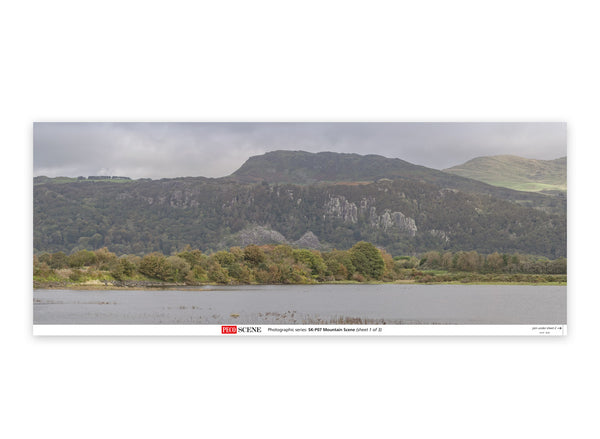
Mountain Range Photographic Backscene (3 Sheets)
Supplied in a square-section tube, the three separate sheets will match perfectly together to form a continuous run of 2400mm (95in), and reaching to a height of 333mm (13in).
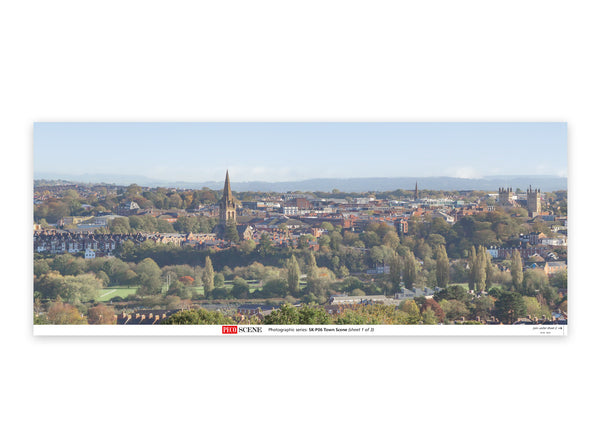
Town Photographic Backscene (3 Sheets)
Supplied in a square-section tube, the three separate sheets will match perfectly together to form a continuous run of 2400mm (95in), and reaching to a height of 333mm (13in).
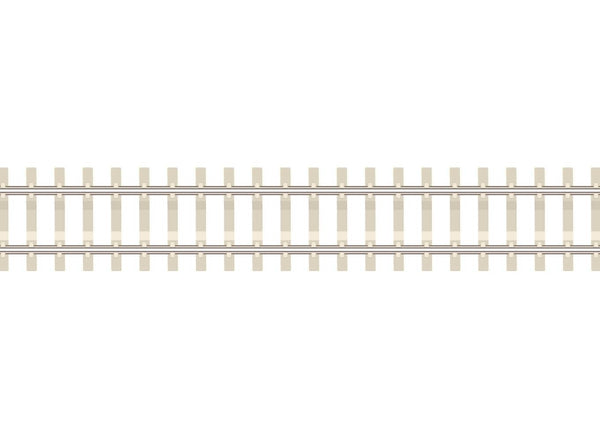
Streamline Flexible Track with Concrete Sleeper
This track models the most common form of concrete sleepering in use in Britain today, with flat bottom rail.
The concrete sleeper detail in SL-303 is vastly improved from the previous SL-302 (now discontinued), with a more prototypical sleeper/tie profile, better representation of the Pandrol-style rail clip and even the manufacturer's name embossed on the surface. Flexible track with nickel silver rail, length 36 inches, 914mm. Supplied in cartons of 25.
N.B Compatible with the existing N scale Code 80 track system, it is also worth reminding that the Code 80 and Code 55 track systems are able to be connected together without the need to compensate for the change in rail height thanks to the clever design of the rail profile and base mouldings of the Code 55 system. The standard SL-310 and SL-311 rail joiners are used for both systems.
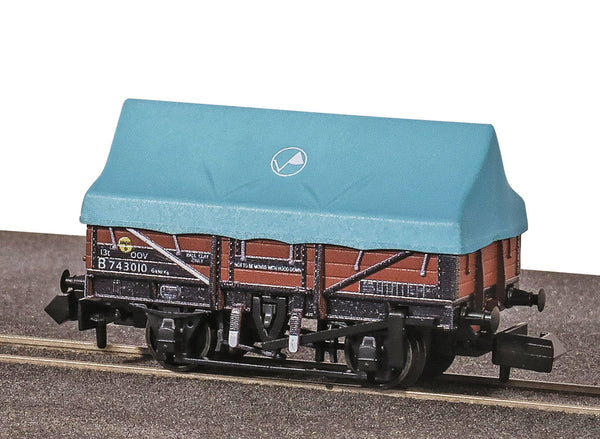
NEW China Clay Hood Wagon, OOV B743010
Railway companies all had a stock of their own vehicles for carrying goods and merchandise around their network, and also onto other companies' routes as and when required. These were integrated into British Railways at Nationalisation; some of them to be once more re liveried under sectorisation as the network was prepared to be returned to private ownership. All PECO wagons feature free running wheels in pin point axles. The ELC coupling, whilst compatible with the standard N gauge couplings, keeps a realistic distance between the vehicles and enables the PL-25 electro magnetic decoupler to be used for remote uncoupling.
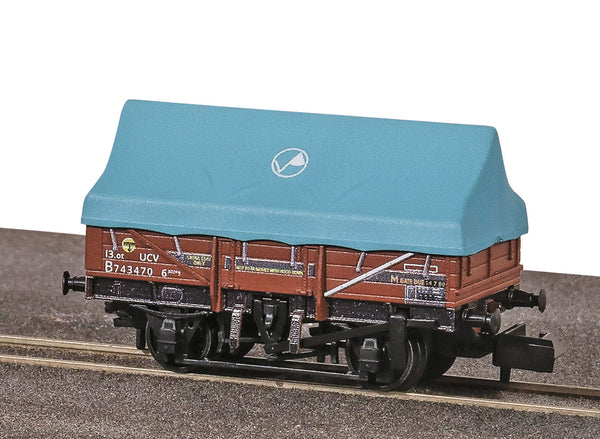
NEW China Clay Hood Wagon, UCV B743470, Bauxite
Railway companies all had a stock of their own vehicles for carrying goods and merchandise around their network, and also onto other companies' routes as and when required. These were integrated into British Railways at Nationalisation; some of them to be once more re liveried under sectorisation as the network was prepared to be returned to private ownership. All PECO wagons feature free running wheels in pin point axles. The ELC coupling, whilst compatible with the standard N gauge couplings, keeps a realistic distance between the vehicles and enables the PL-25 electro magnetic decoupler to be used for remote uncoupling.
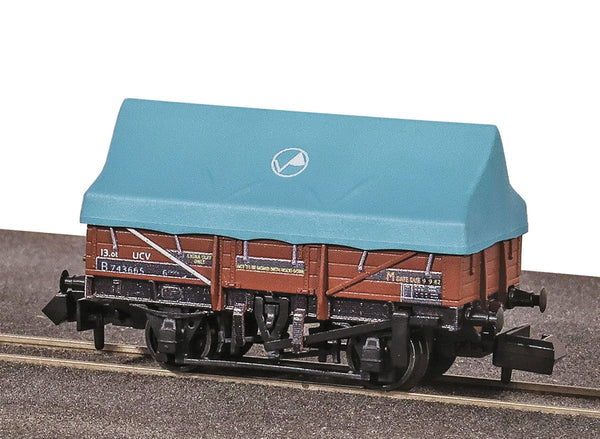
NEW China Clay Hood Wagon, UCV B743665, Bauxite
Railway companies all had a stock of their own vehicles for carrying goods and merchandise around their network, and also onto other companies' routes as and when required. These were integrated into British Railways at Nationalisation; some of them to be once more re liveried under sectorisation as the network was prepared to be returned to private ownership. All PECO wagons feature free running wheels in pin point axles. The ELC coupling, whilst compatible with the standard N gauge couplings, keeps a realistic distance between the vehicles and enables the PL-25 electro magnetic decoupler to be used for remote uncoupling.
OO Bullhead Large Radius Y Turnout
The PECO Streamline OO Bullhead track range has shaped up to be a very comprehensive system comprising flexible track, bullhead joiners, buffer stop, large radius, medium radius turnout, a crossing, double & single slips and now Y turnouts. There's enough there already for modellers to build a truly authentic steam-to-diesel transition period layout.
- PECO Streamline OO Bullhead Large Radius Y Turnout, Unifrog
- Shares the same geometry as the existing Streamline Code 100, 75 flat bottom tracks systems
- Compatible with existing Bullhead system
- Uses standard SL-110 Code 75 rail joiner or the SL-114 Bullhead rail joiner
- Length 220mm, 8.7 inches
- Radius 1829mm, 72 inches
- Frog angle 12 degrees
- Unifrog
- High quality nickel silver rail for all rail parts, for optimal electrical conductivity
- One-piece machined point blade
- Over-centre spring to lock the point blade in place
- An excellent track component where space restrictions prevent standard turnouts being used, such as in a goods yard.
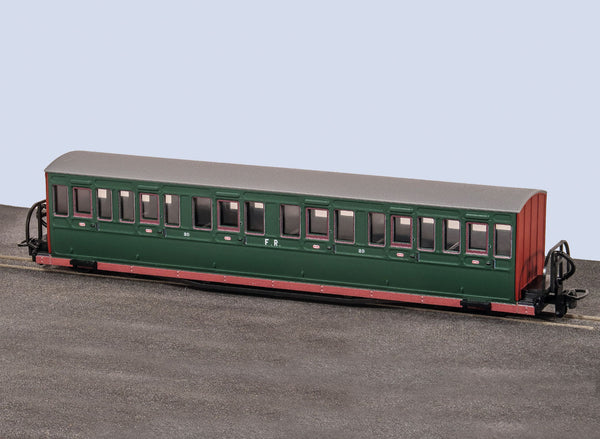
FR Long 'Bowsider' Coach - Colonel Stephens No.20
The Ffestiniog Railway operated two pairs of bogie coaches numbered 17-20 and built by Brown Marshalls & Co and Gloucester Wagon Co. They were known as ‘Bowsiders’ because of the tumblehome shape of their sides. Numbers 17 and 18, built in 1876 are shorter with one 1st class compartment. Numbers 19 and 20, built in 1879 are longer with two 1st class compartments. All four are still in service on the Ffestiniog Railway today.
In the 1920s the elaborate liveries of the Victorian era were replaced with a simple scheme of green with red end panels. It became known as the ‘Colonel Stephens’ livery, after the General Manager of the Ffestiniog Railway from 1925 until his passing in 1931. The colour scheme was used until the end of passenger operations in 1939, sometimes alongside other colours such as yellow, in the mid 1930s.
Green with red ends was applied to carriage No.20 once again from 2005 until 2024, as depicted by GR-623B.
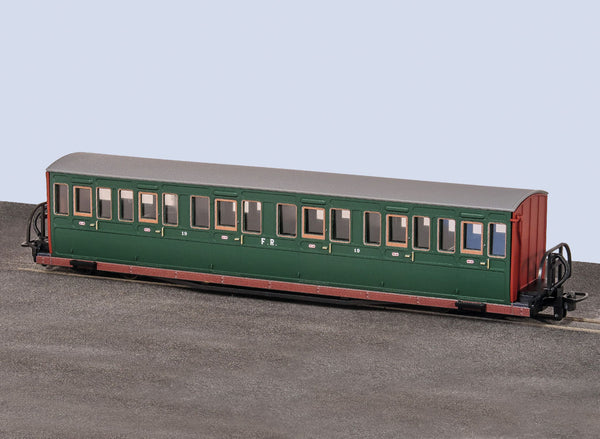
FR Long 'Bowsider' Coach - Colonel Stephens No.19
The Ffestiniog Railway operated two pairs of bogie coaches numbered 17-20 and built by Brown Marshalls & Co and Gloucester Wagon Co. They were known as ‘Bowsiders’ because of the tumblehome shape of their sides. Numbers 17 and 18, built in 1876 are shorter with one 1st class compartment. Numbers 19 and 20, built in 1879 are longer with two 1st class compartments. All four are still in service on the Ffestiniog Railway today.
In the 1920s the elaborate liveries of the Victorian era were replaced with a simple scheme of green with red end panels. It became known as the ‘Colonel Stephens’ livery, after the General Manager of the Ffestiniog Railway from 1925 until his passing in 1931. The colour scheme was used until the end of passenger operations in 1939, sometimes alongside other colours such as yellow, in the mid 1930s.
Green with red ends was applied to carriage No.20 once again from 2005 until 2024, as depicted by GR-623B.
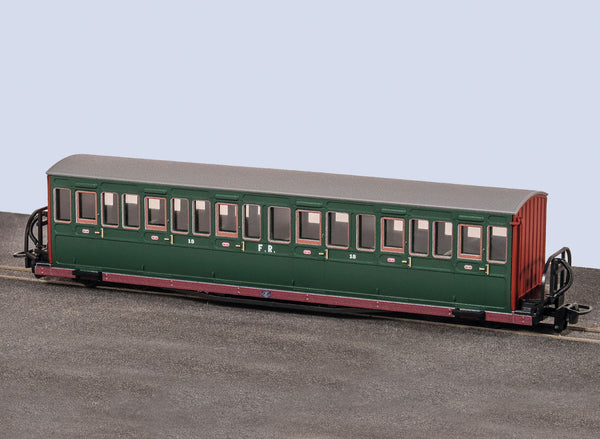
FR Short 'Bowsider' Coach - Colonel Stephens No.18
The Ffestiniog Railway operated two pairs of bogie coaches numbered 17-20 and built by Brown Marshalls & Co and Gloucester Wagon Co. They were known as ‘Bowsiders’ because of the tumblehome shape of their sides. Numbers 17 and 18, built in 1876 are shorter with one 1st class compartment. Numbers 19 and 20, built in 1879 are longer with two 1st class compartments. All four are still in service on the Ffestiniog Railway today.
In the 1920s the elaborate liveries of the Victorian era were replaced with a simple scheme of green with red end panels. It became known as the ‘Colonel Stephens’ livery, after the General Manager of the Ffestiniog Railway from 1925 until his passing in 1931. The colour scheme was used until the end of passenger operations in 1939, sometimes alongside other colours such as yellow, in the mid 1930s.
Green with red ends was applied to carriage No.20 once again from 2005 until 2024, as depicted by GR-623B.
FR Short 'Bowsider' Coach - Colonel Stephens No.17
The Ffestiniog Railway operated two pairs of bogie coaches numbered 17-20 and built by Brown Marshalls & Co and Gloucester Wagon Co. They were known as ‘Bowsiders’ because of the tumblehome shape of their sides. Numbers 17 and 18, built in 1876 are shorter with one 1st class compartment. Numbers 19 and 20, built in 1879 are longer with two 1st class compartments. All four are still in service on the Ffestiniog Railway today.
In the 1920s the elaborate liveries of the Victorian era were replaced with a simple scheme of green with red end panels. It became known as the ‘Colonel Stephens’ livery, after the General Manager of the Ffestiniog Railway from 1925 until his passing in 1931. The colour scheme was used until the end of passenger operations in 1939, sometimes alongside other colours such as yellow, in the mid 1930s.
Green with red ends was applied to carriage No.20 once again from 2005 until 2024, as depicted by GR-623B.
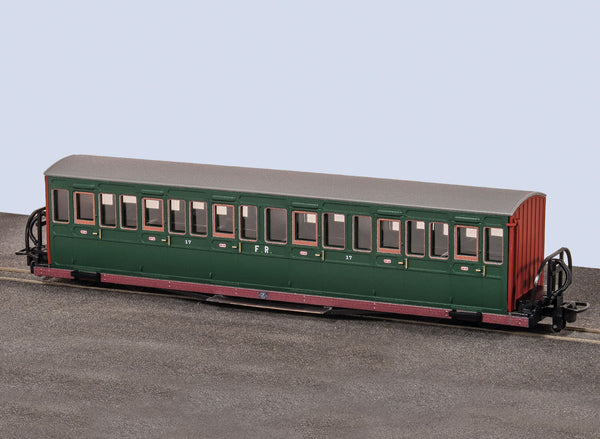
FR Long 'Bowsider' Coach - Red & Cream No.20
The Ffestiniog Railway operated two pairs of bogie coaches numbered 17-20 and built by Brown Marshalls & Co and Gloucester Wagon Co. They were known as ‘Bowsiders’ because of the tumblehome shape of their sides. Numbers 17 and 18, built in 1876 are shorter with one 1st class compartment. Numbers 19 and 20, built in 1879 are longer with two 1st class compartments. All four are still in service on the Ffestiniog Railway today.
The red and cream livery was first applied to a rake of carriages in 1987 for the ‘Mountain Prince’ train service. Carriage 20 was the first Bowsider to appear in the livery.
Carriages 17 and 18 had cream applied to the full upper half of the carriage. 17 had the mouldings reinstated in 1990 as depicted by GR-602A. 18 continued to have cream across the upper half throughout its time in the scheme, as represented by GR-602B. Note the ‘Brown Marshalls & Co. Ltd’ builders plate printed on the ends of the carriage.
All four Bowsiders were repainted into historic liveries in the 2000s, but the red and cream colour scheme is still seen today on the more modern carriages
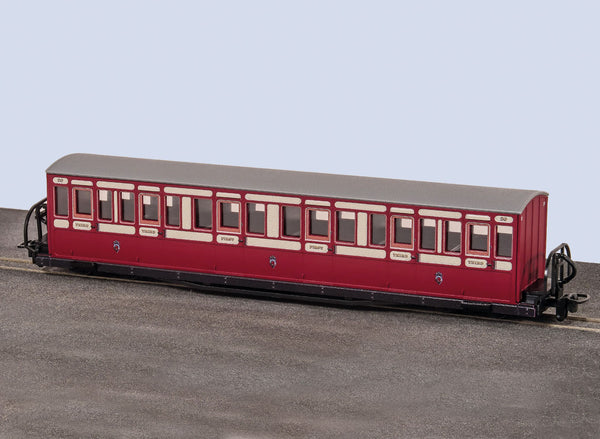
FR Long 'Bowsider' Coach - Red & Cream No.19
The Ffestiniog Railway operated two pairs of bogie coaches numbered 17-20 and built by Brown Marshalls & Co and Gloucester Wagon Co. They were known as ‘Bowsiders’ because of the tumblehome shape of their sides. Numbers 17 and 18, built in 1876 are shorter with one 1st class compartment. Numbers 19 and 20, built in 1879 are longer with two 1st class compartments. All four are still in service on the Ffestiniog Railway today.
The red and cream livery was first applied to a rake of carriages in 1987 for the ‘Mountain Prince’ train service. Carriage 20 was the first Bowsider to appear in the livery.
Carriages 17 and 18 had cream applied to the full upper half of the carriage. 17 had the mouldings reinstated in 1990 as depicted by GR-602A. 18 continued to have cream across the upper half throughout its time in the scheme, as represented by GR-602B. Note the ‘Brown Marshalls & Co. Ltd’ builders plate printed on the ends of the carriage.
All four Bowsiders were repainted into historic liveries in the 2000s, but the red and cream colour scheme is still seen today on the more modern carriages
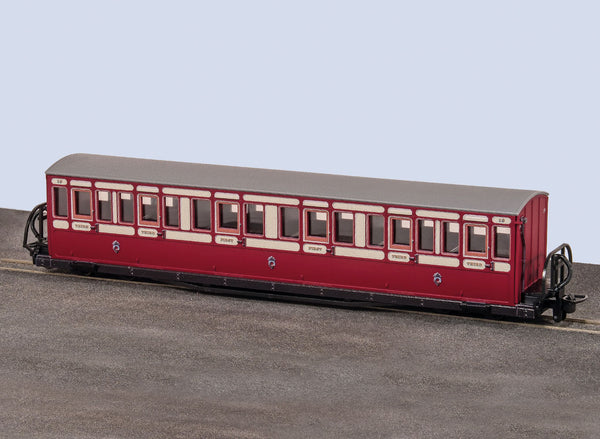
FR Short 'Bowsider' Coach - Red & Cream No.18
The Ffestiniog Railway operated two pairs of bogie coaches numbered 17-20 and built by Brown Marshalls & Co and Gloucester Wagon Co. They were known as ‘Bowsiders’ because of the tumblehome shape of their sides. Numbers 17 and 18, built in 1876 are shorter with one 1st class compartment. Numbers 19 and 20, built in 1879 are longer with two 1st class compartments. All four are still in service on the Ffestiniog Railway today.
The red and cream livery was first applied to a rake of carriages in 1987 for the ‘Mountain Prince’ train service. Carriage 20 was the first Bowsider to appear in the livery.
Carriages 17 and 18 had cream applied to the full upper half of the carriage. 17 had the mouldings reinstated in 1990 as depicted by GR-602A. 18 continued to have cream across the upper half throughout its time in the scheme, as represented by GR-602B. Note the ‘Brown Marshalls & Co. Ltd’ builders plate printed on the ends of the carriage.
All four Bowsiders were repainted into historic liveries in the 2000s, but the red and cream colour scheme is still seen today on the more modern carriages
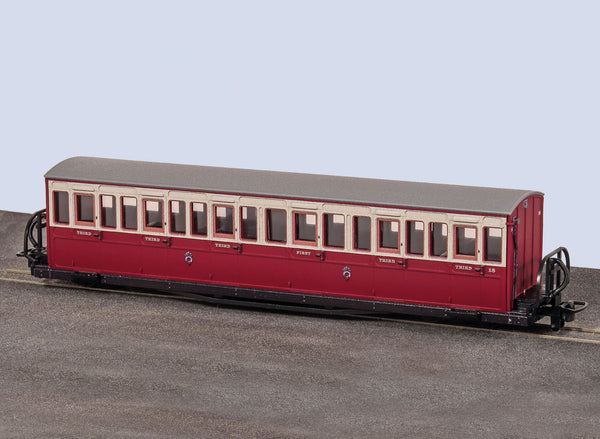
FR Short 'Bowsider' Coach - Red & Cream No.17
The Ffestiniog Railway operated two pairs of bogie coaches numbered 17-20 and built by Brown Marshalls & Co and Gloucester Wagon Co. They were known as ‘Bowsiders’ because of the tumblehome shape of their sides. Numbers 17 and 18, built in 1876 are shorter with one 1st class compartment. Numbers 19 and 20, built in 1879 are longer with two 1st class compartments. All four are still in service on the Ffestiniog Railway today.
The red and cream livery was first applied to a rake of carriages in 1987 for the ‘Mountain Prince’ train service. Carriage 20 was the first Bowsider to appear in the livery.
Carriages 17 and 18 had cream applied to the full upper half of the carriage. 17 had the mouldings reinstated in 1990 as depicted by GR-602A. 18 continued to have cream across the upper half throughout its time in the scheme, as represented by GR-602B. Note the ‘Brown Marshalls & Co. Ltd’ builders plate printed on the ends of the carriage.
All four Bowsiders were repainted into historic liveries in the 2000s, but the red and cream colour scheme is still seen today on the more modern carriages
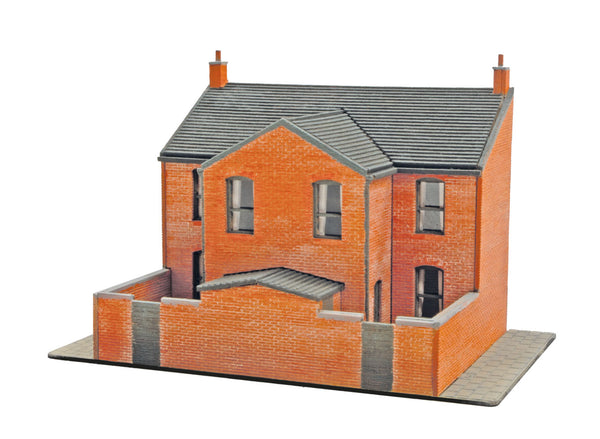
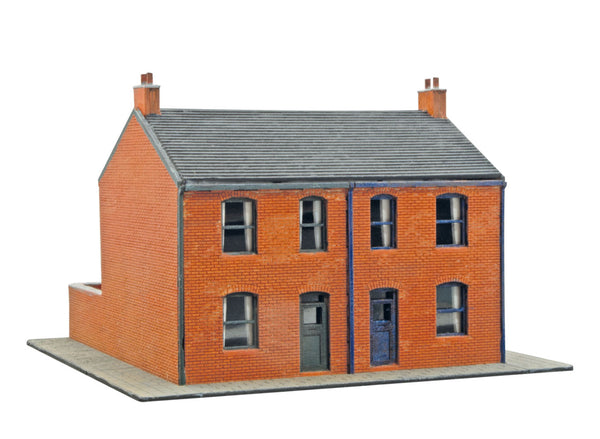
Victorian House Complete, Lasercut Kit
The British Victorian red brick townhouse emerged during Queen Victoria's reign (1837–1901), reflecting the era's industrial and architectural advances. With the advent of mass brick production and rail transport, red bricks became affordable and widely available. Victorian architecture embraced Gothic Revival, Italianate, and Queen Anne styles, characterised by ornate detailing, bay windows, gables, and decorative brickwork. Red brick houses symbolised urban prosperity, particularly in growing industrial cities. Their durability and aesthetic appeal made them iconic in suburbs and working-class areas alike. Today, these houses endure as a hallmark of Victorian design, blending function with the artistic aspirations of the era.
Victorian House Backs, Lasercut Kit
The British Victorian red brick townhouse emerged during Queen Victoria's reign (1837–1901), reflecting the era's industrial and architectural advances. With the advent of mass brick production and rail transport, red bricks became affordable and widely available. Victorian architecture embraced Gothic Revival, Italianate, and Queen Anne styles, characterised by ornate detailing, bay windows, gables, and decorative brickwork. Red brick houses symbolised urban prosperity, particularly in growing industrial cities. Their durability and aesthetic appeal made them iconic in suburbs and working-class areas alike. Today, these houses endure as a hallmark of Victorian design, blending function with the artistic aspirations of the era.